
FIX THIS TOWN!
Last Friday, July 17th, we had our sixth Architectural Session at the Parrish Museum. In these sessions, modeled after jazz improvisations, I speak with architects (and sometimes artists whose work overlaps architecture) about their work.
But last Friday's sessions was about the future of the towns on the East End of Long Island. With my guests, Felipe Correa (Harvard GSD), and Jay Schneiderman (Suffolk County Legislator), and David Rattray (editor of East Hampton Start), we discussed the issues that face the towns on the East End of Long Island as they grow in population every year; and we talked about the urban future that we want to envision for ourselves and others.
The conversation was informative and animated and allowed the audience to raise their concerns, voice their wishes, and have a public conversation about an issue that so far has been kept out of the public realm.
The program was broadcast live. And an edited video of it will be available soon.
Thanks to the AIA Peconic and its membership for the support of the program.

from left: David Rattray, editor, East Hampton Star (standing), Maziar Behrooz, Architect, Jay Schneiderman, Suffolk County Legislator, Felipe Correa, Department of Urban Planning , Harvard GSD
PRO-BONO: Architects Who Serve Humanity
In the next installment of Architectural Sessions, Maziar Behrooz will interview architects who volunteer their time toward charitable causes, featuring special guests Sharon Davis, the New York-based architect who, in collaboration with Women for Women, created the Women's Opportunity Center for female survivors of war in Kayonza, Rwanda and artist/philanthropist Jane Walentas who founded the non-profit organization Jane's Carousel, overseeing the restoration of the Brooklyn landmark and creation of its Jean Nouvel-designed pavilion.
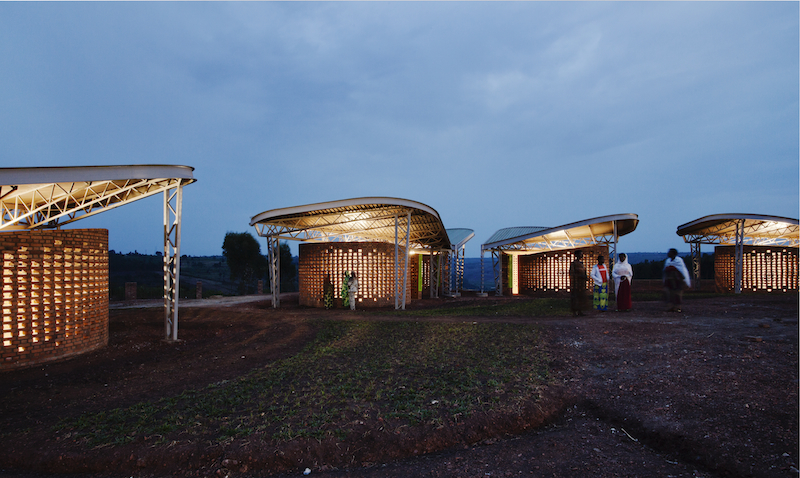
Women's Opportunity Center, Rwanda, Sharon Davis Design
A Note on My First House
The first house I built in East Hampton was long before the words 'sustainability' or 'green' were in our common vernacular. In fact with less than a handful of exceptions every house or building on the East End of Long Island was designed in a variation, often deformation, of the 'Shingle Style' [click this to read about the Shingle Style]. Modernism on the East End, while vibrant, experimental and profoundly captivating in the 60s and 70s, was hardly to be seen in the 90s. Developers, homeowners, realtors, with a unified front, wanted everything shingled. It was in this environment that I opened the office in East Hampton and began from the start to re-envision how a house could be designed or built.
I built my first house in East Hampton long before the words "sustainability" or "green" were common vernacular. In fact with less than a handful of exceptions every house or building on the East End of Long Island was designed in a variation, often deformation, of the 'Shingle Style' [click this to read about the Shingle Style]. Modernism on the East End, while vibrant, experimental and profoundly captivating in the 60s and 70s, was hardly to be seen in the 90s. Developers, homeowners, realtors, with a unified front, wanted everything shingled. It was in this environment that I opened the office in East Hampton and began from the start to re-envision how a house could be designed or built.
I recall a developer who came to my office and after seeing my portfolio of more modern architecture, asked to see more 'traditional designs'. And I promptly referred him to the phone-book as nearly 30 out of the 33 architects practicing on the East End were already proficient designers of buildings that look old. I didn't see the need to be architect #34 in that line; but more, while I was enamored with the salt-boxes, the homes of Stanford White in Montauk, or some of the more common rambling gable-roofed houses of the past century, these were not the reasons I went to architecture school. So I stuck with what I liked to do and slowly, but with confidence, began to design my first house in Georgica on land that I purchased before the 'Hamptons' were referred to with one word.
The house in Georgica took its cues from the drawings, site plans and constructed buildings that the Shakers developed -with a simplicity that is hard to match. It consisted of two barn-like shapes and a flat-roofed bridge in between, with an interior that was open. It was a hybrid and as a design strategy it has become much more common than it was in those early days.
I've done many houses, buildings and other types of projects since then. While always maintaining a steady approach, I see that the public sentiment is now fully shifted to where I started. Everyone wants a 'modern' building now. Contractors and builders who reluctantly answered our calls many years ago, now call persistently to get in on the action.
We find ourselves in a good place; everyone has come around. But there is a problem. I'm already on to the next thing.
Sayres House & Hanging Gardens featured on NBC TV
Architect Maziar Behrooz shows us his inspiration and design for this truly unique home with its asymmetrical lines and jutting extensions.

Sayres House on Open House TV, NBC Channel 4 (click image to go to video)
Architectural Sessions IV: Soft Footprints: Projects by SO-IL
A conversation on architecture hosted by architect Maziar Behrooz (New York) with special guests Florian Idenburg and Jing Liu, co-founders of SO – IL, with support from AIA Peconic.