

MB Arch + present a Vision Plan for the Village of East Hampton at Parrish Art Museum
MB Arch + Team presenting its vision-plan of the Village of East Hampton at the Parrish Art Museum.
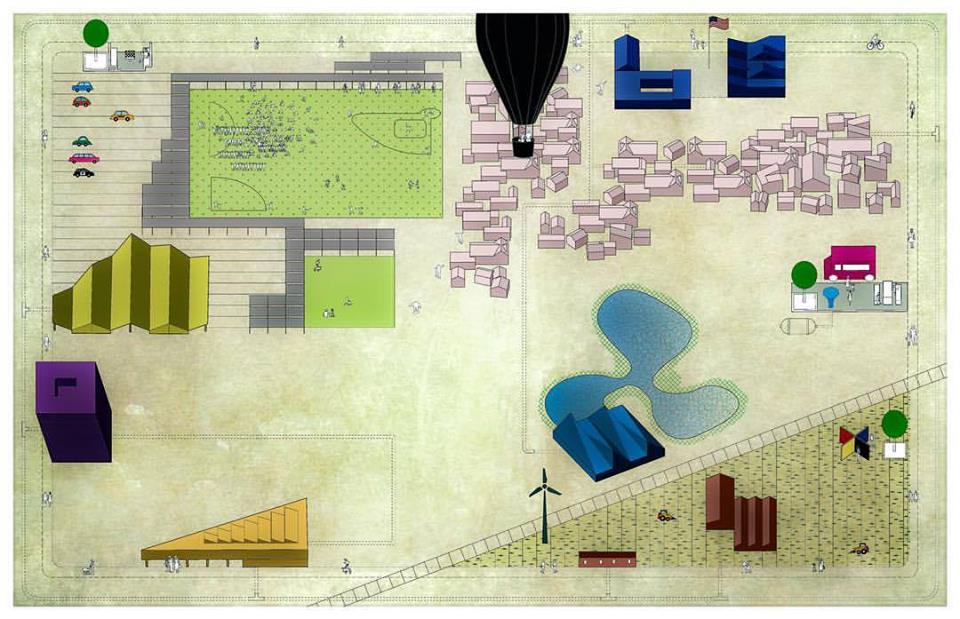
On August 31, the MB Arch team will present our summer-long research, design and vision-planning of the Village of East Hampton.
We set out to respect and extend the village-ness of East Hampton by proposing a variety of small “moves”: a new pedestrian connection here, optimizing relationships between active, passive, and circulation spaces in a park there, gathering civic functions on the right corner… Any one proposition is a practical and feasible enhancement; over time, they will add up to the right fabric– congenial, eclectic, human in scale. Every time we take one step forward it’s with a whole idea in mind, towards what East Hampton wanted to be in the first place.
A Note on My First House
The first house I built in East Hampton was long before the words 'sustainability' or 'green' were in our common vernacular. In fact with less than a handful of exceptions every house or building on the East End of Long Island was designed in a variation, often deformation, of the 'Shingle Style' [click this to read about the Shingle Style]. Modernism on the East End, while vibrant, experimental and profoundly captivating in the 60s and 70s, was hardly to be seen in the 90s. Developers, homeowners, realtors, with a unified front, wanted everything shingled. It was in this environment that I opened the office in East Hampton and began from the start to re-envision how a house could be designed or built.
I built my first house in East Hampton long before the words "sustainability" or "green" were common vernacular. In fact with less than a handful of exceptions every house or building on the East End of Long Island was designed in a variation, often deformation, of the 'Shingle Style' [click this to read about the Shingle Style]. Modernism on the East End, while vibrant, experimental and profoundly captivating in the 60s and 70s, was hardly to be seen in the 90s. Developers, homeowners, realtors, with a unified front, wanted everything shingled. It was in this environment that I opened the office in East Hampton and began from the start to re-envision how a house could be designed or built.
I recall a developer who came to my office and after seeing my portfolio of more modern architecture, asked to see more 'traditional designs'. And I promptly referred him to the phone-book as nearly 30 out of the 33 architects practicing on the East End were already proficient designers of buildings that look old. I didn't see the need to be architect #34 in that line; but more, while I was enamored with the salt-boxes, the homes of Stanford White in Montauk, or some of the more common rambling gable-roofed houses of the past century, these were not the reasons I went to architecture school. So I stuck with what I liked to do and slowly, but with confidence, began to design my first house in Georgica on land that I purchased before the 'Hamptons' were referred to with one word.
The house in Georgica took its cues from the drawings, site plans and constructed buildings that the Shakers developed -with a simplicity that is hard to match. It consisted of two barn-like shapes and a flat-roofed bridge in between, with an interior that was open. It was a hybrid and as a design strategy it has become much more common than it was in those early days.
I've done many houses, buildings and other types of projects since then. While always maintaining a steady approach, I see that the public sentiment is now fully shifted to where I started. Everyone wants a 'modern' building now. Contractors and builders who reluctantly answered our calls many years ago, now call persistently to get in on the action.
We find ourselves in a good place; everyone has come around. But there is a problem. I'm already on to the next thing.
PULSE_RDMU
PULSE_RDMU, an audio/video piece by Matthew Biedrman & Alain Thibault (website) performed in the RDMU for the Parrish Museum, Southampton, NY.

PULSE_RDMU, an audio/video piece by Matthew Biedrman & Alain Thibault (website) performed in the RDMU for the Parrish Museum, Southampton, NY.