
Museum of Stored Art
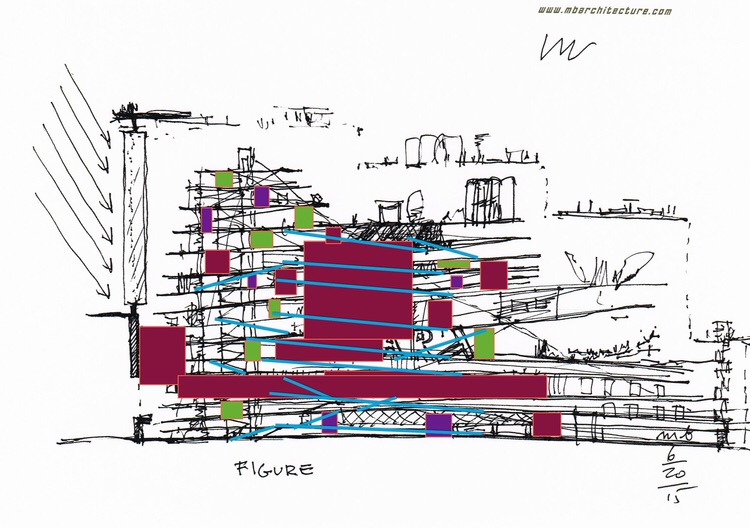
Our proposal for a museum of stored art in Chelsea, Manhattan.
Four adjacent buildings are reconfigured and restored to house facilities for the storage of private and none-private art, with adjacent public and private spaces for the display and sale of art. [Click here to see project.]
The overlap of particular socio-economic tides —the rise of a shared economy that harnesses unattended markets, the proliferation of private art collections, the lack of sufficient spaces of public and communal activity, and the democratization of art viewing— has fostered an environment in which our proposal for a Museum of Stored Art is both timely and important.
Working with four contiguous under-developed buildings adjacent to the ‘Highline’ in Chelsea, we have explored the multiple design facets of a building that straddles the boundary between private art collection and public art viewing.
We have studied the nuanced and often challenging needs of storage of significant works of art and the delicate but rewarding benefit of publicly displaying both the ‘art of storage’ and the stored art.
In one scoop, by providing a space for private art collections to be viewed publicly, we connect the philanthropic intents of individuals with a public need, benefitting a community and its individuals.
The need for this type of building became evident to me as I began to design spaces for the collections of my clients. At the same time, our Chelsea office is next to one of the premiere art-storage facilities in the USA. I began to wonder what is contained in this storage building? And how wonderful it would be for the public to be able to see curated shows cross-referencing various collections.
The following images are the result of our initial foray into understanding the needs of such a building, its complex security concerns, and its incredible art-viewing opportunities.

Architectural Sessions at the Parrish
In the second installment of AIA Peconic’s Architectural Sessions at the Parrish, host Maziar Behrooz is joined by Thomas Phifer, principal of Thomas Phifer and Partners, and Gabriel Smith, partner, for a conversation about the firm’s singular approach to architecture.

Glenstone, Potomac MD USA by Thomas Phifer
In the second installment of AIA Peconic’s Architectural Sessions at the Parrish, host Maziar Behrooz is joined by Thomas Phifer, principal of Thomas Phifer and Partners, and Gabriel Smith, partner, for a conversation about the firm’s singular approach to architecture.
"We're into very quiet architecture," says Thomas Phifer. With forms that aim for permanence and simplicity, their buildings articulate an intense precision in both craft and concept. A singular vision is examined and expressed with clarity and deliberateness throughout their buildings, elevating every view, every space to an essential and timeless condition. In the firm’s current project, the expansion of the Glenstone Museum (anticipated to open in 2016), the changing patterns of nature play against the quiet permanence of forms.
This Session will examine how a practice like Phifer’s can maintain such focus and clarity of vision from a project’s conception to completion. What systems are in place to ensure that the in-house team can express a singular idea over time to the many parties and stakeholders involved in the creation of a building, and ultimately to the public at large?
Thomas Phifer
Thomas Phifer, who founded his New York City-based firm Thomas Phifer and Partners in 1997, “approaches modernism,” in his own words, “from a humanistic standpoint, connecting the built environment to the natural world with a heightened sense of openness and community spirit that is based on a collaborative, interdisciplinary process.” The firm’s work includes the North Carolina Museum of Art in Raleigh and the Brochstein Pavilion at Rice University in Houston, as well as a number of residential commissions in the Hudson River Valley. Current projects, designed with “a natural economy of elements through order grounded in nature and predicated on conservation” include an expansion of the Corning Museum of Glass in Corning, New York; a new museum for the Glenstone Foundation in Potomac, Maryland; a Federal Office Building in San Juan, Puerto Rico; and houses in Madison, Wisconsin and Dallas.The firm’s buildings have received numerous AIA National and New York Honor Awards. Phifer has received the Medal of Honor from the New York Chapter of the AIA, the Rome Prize from the American Academy in Rome, and, in 2013, the Arts and Letters Award in Architecture from the American Academy of Arts and Letters. He has taught at numerous architecture schools including Cornell University, the University of Pennsylvania, and the University of Texas.
Gabriel Smith
Gabriel Smith joined Thomas Phifer and Partners in 2005 and became a Director in 2010. Mr. Smith has extensive experience at both Thomas Phifer and Partners and previous firms on museums and cultural institutions, having worked in London for the offices of Skidmore, Owings and Merrill and Norman Foster & Partners, at Allied Architecture + Design in San Francisco, and at Eskew+Dumez+Ripple Architects in New Orleans, where he served as Project Architect for the University of Louisiana Lafayette Art Museum in Lafayette, Louisiana. He received a Bachelor of Architecture and Master of Architecture from Tulane University, and a Master of Architecture from the Harvard University Graduate School of Design. He is a LEED Accredited Professional, a member of the American Institute of Architects, and is a registered Architect in the state of Louisiana.
Maziar Behrooz
Maziar Behrooz founded MB Architecture in the 1990s in Manhattan and
established an office in East Hampton in 1996. Over the past 18 years
they have created a variety of projects and buildings from sustainably
designed single family homes to affordable housing, from East Hampton to
Montauk, and in New York, New Orleans and overseas. Their work has been
recognized for its functionalism, innovation and sustainable design and
often involves civic, community and art projects. Maziar attended the
Tulane School of Architecture, the Institute for Architecture &
Urban Studies and Cornell School of Architecture. He is a member of the
AIA, USGBC and Tulane School of Architecture Board of Advisors.
Tickets